


February 22, 2023


Material Needed to Take Out a Load Bearing Wall Safely
The challenge of load bearing wall removal is not demolition itself, but replacing the structural role it once played. This type of wall supports weight from above, and once it is removed, that load must be redirected safely and permanently through other structural elements.
This is where material selection becomes critical. Using the wrong beam, undersized posts, or inadequate temporary supports can create structural problems that are not immediately visible but develop over time. Floors may sag, finishes may crack, and doors may stop closing properly. In more serious cases, inspections fail or structural repairs become necessary.
If you are planning a load bearing wall removal, choosing the correct materials before work begins is essential to long-term safety and performance.
Professional load bearing wall removal services focus on selecting and installing materials that correctly handle the loads involved, not just removing framing.
This guide explains the materials required to take out a load bearing wall safely, why each material matters, and how they work together as a system rather than as individual components.
Why Material Selection Matters in Load Bearing Wall Removal
A load bearing wall does not simply hold itself up – it transfers weight from floors, walls, and roof framing above down into the structure below. When the wall is removed, that load does not disappear, so it must be picked up by new materials designed to carry it safely.
Loads must be redirected, not reduced
One of the most common misconceptions in residential renovations is that removing a wall somehow reduces structural load. In reality, the same weight still exists. The only thing that changes is how that weight travels through the house.
That being said, the materials used to replace a load bearing wall must be capable of:
- carrying the full structural load
- transferring that load to proper supports
- limiting deflection over time
- performing reliably for the life of the home
This is why material choice is not interchangeable or cosmetic. Structural materials must be selected based on load requirements, span length, and support conditions.
Safety depends on the entire system, not one piece
Another frequent mistake is focusing only on the beam while overlooking the materials below it. A properly sized beam can still create problems if the posts beneath it are undersized or if the floor or foundation cannot support the new concentrated loads.
Safe wall removal depends on many materials working together:
- temporary wall support
- permanent beams
- posts or columns
- connectors and fasteners
- foundations or footings
Each material plays a specific role, and skipping or underestimating any one of them increases risk.
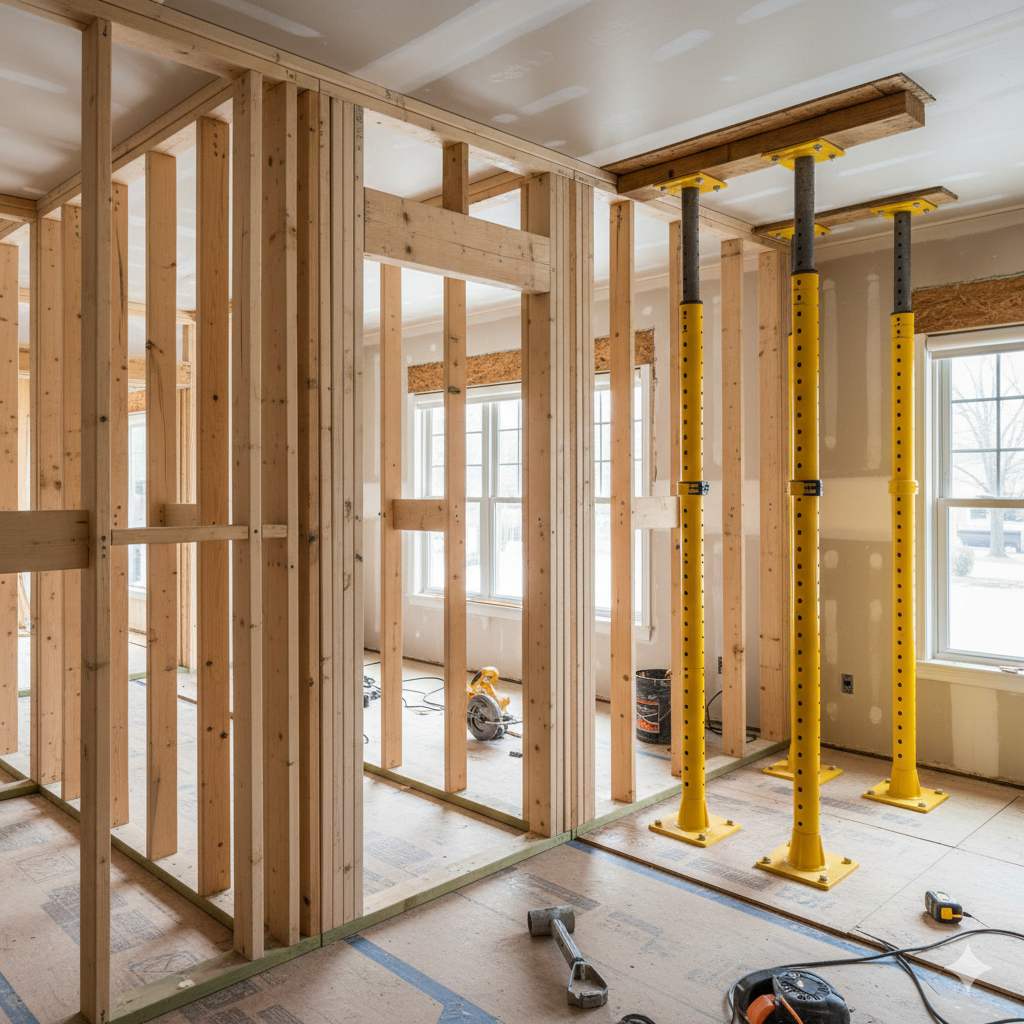
Temporary Support Materials Used Before Wall Removal
Before any wall can be removed, the structure above must be supported temporarily. Let’s explore how.
Temporary stud walls and framing lumber
Temporary support walls are typically built using standard dimensional lumber such as:
- 2×4 or 2×6 studs
- top and bottom plates
- framing nails or structural screws
These walls are installed parallel to the load bearing wall being removed, usually on both sides. Their purpose is to carry the load temporarily while the permanent materials are installed.
The spacing, placement, and construction of these temporary walls matter. Improperly built temporary supports can shift, settle, or fail during demolition, creating unsafe conditions.
Shoring posts and adjustable supports
While temporary stud walls are commonly used in residential renovations, many professional load bearing wall removal specialists prefer shoring posts and adjustable supports for a faster and more reliable job.
Unlike temporary stud walls, which must be framed, nailed, and later removed, shoring posts are installed directly beneath load points and adjusted to apply controlled support. This makes them especially effective in homes with limited space, finished floors, or complex framing conditions. Because each post is individually adjustable, loads can be transferred evenly and monitored throughout the process.
Structural Beams Used to Replace Load Bearing Walls
Once temporary supports are in place, the permanent beam becomes the primary element responsible for carrying the load previously supported by the wall. The type of beam used depends on span length, load demands, framing layout, and how the finished space will be constructed.
LVL and similar engineered wood beams
Laminated Veneer Lumber, commonly referred to as LVL, is widely used in residential construction because it provides consistent strength and predictable performance. These beams are manufactured to meet defined structural standards and are available in a range of depths and thicknesses that integrate well with typical framing systems. While LVLs are reliable materials, their effectiveness depends on proper sizing and support. Using an LVL alone does not ensure safety if it is not matched to the specific conditions of the house.
Glulam beams for longer spans or exposed conditions
Glue laminated beams, often called glulams or power beams, are formed by bonding layers of lumber together and are used when longer spans are required or when the beam will remain visible in the finished space. These beams are available in both structural and architectural grades, which makes appearance an additional consideration. As with LVLs, glulams must be selected based on load requirements as well as how they connect to surrounding framing.
Girder trusses and specialty framing assemblies
In some situations, particularly where roof or floor framing is complex, girder trusses or custom framing assemblies are used to redistribute loads. These solutions are less common in typical residential projects and require careful coordination with existing framing to ensure loads are transferred correctly.
Steel Beams
In many load bearing wall removal projects, this is the preferred material due to their strength, consistency, and ability to handle demanding structural conditions with minimal depth.
Because steel does not shrink, warp, or vary from piece to piece, it provides highly predictable performance over time. This makes it especially well suited for homes with tight clearances, multi-story load paths, or situations where maintaining ceiling height is a priority.
Choosing the perfect beam for your project also involves taking into consideration the materials that will support it.
Posts, Columns, and Load Transfer Materials Below the Beam
A beam is only as effective as the materials supporting it.
Wood and steel posts
Posts beneath beams may be constructed from:
- built-up dimensional lumber
- engineered wood columns
- steel posts or columns
The correct post material depends on load magnitude, available space, and how the load is transferred below. Posts must be sized correctly to avoid crushing, buckling, or long-term settlement.
Connections, fasteners, and hardware
Structural connectors play a critical role in load bearing wall removal. These include:
- post caps
- beam hangers
- structural screws and bolts
- metal plates and brackets
Improper or missing connectors can compromise an otherwise well-designed system. Materials must be installed according to manufacturer specifications to perform as intended.
Foundations, Footings, and Supporting Structure Materials
Removing a load bearing wall often introduces new concentrated loads that the original structure was not designed to handle.
Existing floors and foundations
The materials below a new post or beam must be evaluated to determine whether they can safely carry the added load. In some cases, existing floor framing or slabs are enough, while in others, reinforcement is required.
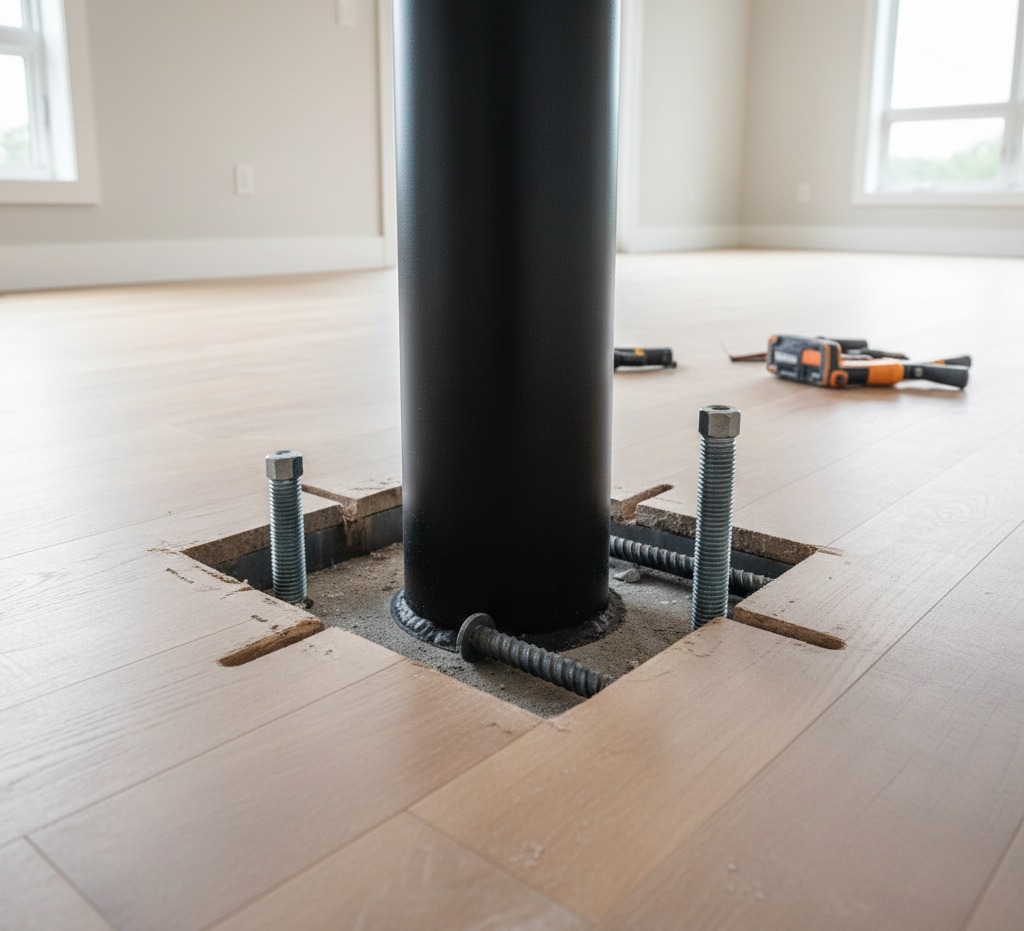
New footings and reinforcement materials
When new footings are needed, additional materials may include:
- concrete footings
- rebar reinforcement
- anchor bolts or embedded connectors
These materials ensure that loads are transferred safely into the ground rather than overstressing existing structural elements.
Structural safety requirements exist to prevent progressive damage, not just immediate failure. In residential construction, materials that carry load must perform reliably over time as conditions change due to occupancy, moisture, and natural movement.
Federal guidance from the Federal Emergency Management Agency notes that improper load transfer and inadequate structural components are among the leading causes of residential structural damage following renovations and alterations. Materials selected to replace a load bearing wall must therefore be capable of supporting sustained loads without excessive movement or long-term degradation, not merely meeting short-term strength expectations.
How Finish Conditions Influence Material Selection
Material decisions for load bearing wall removal are not based on structure alone. How the finished space will look and function after the wall is removed also plays an important role in selecting the right materials.
Concealed versus exposed structural materials
When a beam will be hidden inside a ceiling or soffit, material selection is driven almost entirely by structural capacity and compatibility with existing framing. Depth, width, and bearing length matter more than appearance, and the goal is often to minimize ceiling drops while still meeting structural requirements.
When a beam will remain exposed, material choice becomes more nuanced. Glulam beams are often selected in these situations because they can provide both structural strength and a finished appearance. The decision to expose a beam affects not only the beam itself, but also the type of connectors, fasteners, and surface treatments required. Materials must be selected with the understanding that they will remain visible for the life of the home.
Ceiling height, floor thickness, and material constraints
Existing ceiling heights and floor thickness can limit material options. In some homes, there is little vertical space available to install a deep beam without altering ceilings above or below. In these cases, material selection must balance structural capacity with dimensional constraints.
This is where experience matters. Choosing materials that technically meet load requirements but create impractical ceiling conditions often leads to additional modifications later. Proper material planning accounts for how the beam, posts, and surrounding framing fit within the existing structure without introducing new problems.
Material Compatibility With Existing Framing and Construction
Another critical factor in safe load bearing wall removal is how new materials interact with the existing structure. Even high-quality materials can underperform if they are not compatible with the framing systems already in place.
Matching materials to existing framing systems
Older homes may use framing methods or lumber sizes that differ from modern standards. Floor joist spacing, framing orientation, and wood species can all affect how loads are transferred once a wall is removed. New beams and posts must be selected with these conditions in mind so that loads are delivered evenly and predictably.
Material compatibility also affects connections. Beams, posts, and framing members must be joined in a way that allows them to act together structurally. Selecting materials that require excessive modification to existing framing often introduces unnecessary risk.
Accounting for past modifications and renovations
Many homes have been altered over time. Walls may have been moved, framing members cut or reinforced, and loads redistributed without clear documentation. Material selection must account for these realities.
New materials should be chosen not only based on original construction assumptions, but on the structure as it exists today. This is especially important when introducing concentrated loads from new beams and posts. Materials that work well in theory can perform poorly if underlying framing or support conditions are inconsistent.
Understanding how new materials interact with existing construction helps prevent unexpected movement, cracking, or long-term structural issues after the wall is removed.

Why Material Choice Is Where Experience Matters Most
Material selection is where professional experience has the greatest impact on safety. While demolition can be straightforward, choosing the correct combination of beams, posts, connectors, and supports requires an understanding of how loads move through a house.
This is why professional structural services are often involved in planning load bearing wall removal projects. The goal is not complexity, but confidence that materials will perform as expected over time.
In the DFW metroplex, Load Bearing Wall Pros source high-quality wood and steel products from trusted manufacturers such as Anthony Forest products, Murphy, Weyerhaeuser, Triple S Steel, CMC, and other top quality manufacturers, ensuring consistent material performance for residential wall removal projects.
FAQ About Load Bearing Wall Removal Material
What is the most common beam material used in residential load bearing wall removal?
There isn’t a single “one-size-fits-all” beam material. In residential projects, beam selection depends on span, loads above, ceiling configuration, and how the structure transfers weight. Steel beams are frequently used because they offer high strength in a compact profile, while engineered wood beams are used when conditions allow.
Can any beam be used to replace a load bearing wall?
No. Whether the beam is steel or engineered wood, it must be properly sized for the specific span, load, and support conditions of the home. Using an undersized or incorrect beam can lead to sagging, cracking, or long-term structural movement.
Are steel beams required to remove a load bearing wall?
Not always, but they are often preferred in residential wall removal. Steel allows longer spans, minimizes ceiling drops, and reduces the overall beam depth compared to wood options.
Do posts and footings matter as much as the beam?
Yes. Posts and foundations are critical to safely transferring loads. A strong beam alone does not guarantee a safe system.
Can materials be reused from an existing wall?
In most cases, no. Materials used in a load bearing wall are not designed to function as beams or posts once the wall is removed.
Clarity Before Construction
Taking out a load bearing wall safely depends on more than removing studs and drywall. It depends on using the right materials to replace the structural role that wall once played.
Beams, posts, temporary supports, and foundations must work together as a system. When they do, load bearing wall removal can be completed safely, predictably, and without long-term structural issues.
If you are planning a project and want confidence that the right materials are selected from the start, reach out to Load Bearing Wall Pros for professional guidance focused on safety, performance, and long-term reliability.
About the Author
Jason Hulcy, the founder of Load Bearing Wall Pros, is a seasoned expert in wall removal and home renovations. With a passion for innovation and sustainability, he has helped countless homeowners achieve their dream spaces safely and efficiently. Learn more about his expertise here.
Recent posts
-

-
 October 26, 2022